Recently, the team led by Professor Yin Hang at the School of Physics of Central China Normal University (CCNU) has made important progress in precision electroweak measurements in particle physics. Two research results led by the team — the measurement of the W-boson charge asymmetry [1] and the measurement of the W-boson production cross section [2] — have been published in the internationally top-tier physics journals Physical Review Letters and Physical Review D, respectively. The studies achieve high-precision measurements of the W-boson production cross section and the muon charge asymmetry in the forward rapidity region, providing important experimental input for precision tests of the Standard Model and for global fits of the proton parton distribution functions (PDFs).
Precision electroweak measurements are an important frontier of current international high-energy physics research and a key pathway toward searching for new physics beyond the Standard Model. As the mediator of the electroweak interaction, the W boson production process not only provides stringent tests of quantum chromodynamics (QCD) and the electroweak theory, but is also highly sensitive to the proton parton distribution functions (PDFs). In particular, the production cross sections of W+ and W− bosons and the kinematic distributions of the final-state muons reflect the distributions of the u and d valence quarks and the sea quarks inside the proton, and therefore constitute indispensable experimental input for global PDF fits. Thanks to its unique forward acceptance, the LHCb data correspond to partons at very large and very small Bjorken-x, offering distinctive advantages for PDF studies.
This study uses data collected by the LHCb experiment at a center-of-mass energy of 13 TeV from 2016 to 2018, and performs a systematic analysis of the relevant events. The team carried out comprehensive optimizations of the muon reconstruction efficiency, the trigger efficiency, the momentum calibration, the background estimation, and the detector response, substantially reducing the systematic uncertainties and achieving the highest-precision measurement of the W-boson production cross section in the forward region. The experimental results are in excellent agreement with the most accurate theoretical calculations, and are expected to significantly improve the constraints on the PDFs. On this basis, the team further measured the muon charge asymmetry in W-boson decays, obtaining the most precise measurement in the forward rapidity region. The experimental precision is now comparable to the current theoretical predictions, providing key experimental input for further reducing the PDF uncertainties and for advancing electroweak precision measurements such as the W-boson mass.
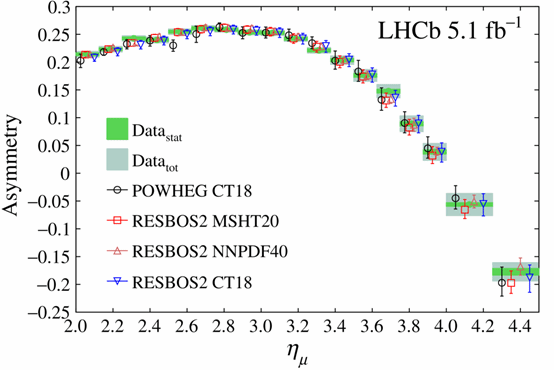
The measured muon charge asymmetry compared with various theoretical predictions
This study was supervised by Professor Yin Hang of CCNU. Doctoral student Deng Jianqiao was responsible for the entire data-analysis workflow and served as corresponding author for the submission of the papers. Dr. Xu Menglin of the European Organization for Nuclear Research (CERN) and Professor Li Hengne of South China Normal University also made important contributions. The research was supported by the General Program of the National Natural Science Foundation of China. The papers are signed by all members of the LHCb Collaboration and, following the international convention in high-energy physics, the authors are listed in alphabetical order by surname.
In recent years, Professor Yin Hang's team has continuously carried out precision electroweak measurements at LHCb, successively completing a series of internationally influential results, including the Z-boson mass measurement (PRL), the weak mixing angle measurement (JHEP), the Z-boson production cross section (JHEP) and polarization measurements (PRL), the W-boson production cross section measurement (PRD), the W-boson charge asymmetry measurement (PRL), and the top-quark charge asymmetry measurement (PRL). The team has gradually formed a distinctive research direction of precision electroweak measurements in the LHC forward region.
References:
[1] Phys. Rev. Lett. 137 (2026) 111801
[2] Phys. Rev. D 114 (2026) 052003