Where does the mass of a hadron actually come from, and can it be accounted for term by term from first principles? Recently, the group of Professor Ding Hengtong at the Institute of Particle Physics, Central China Normal University, together with collaborators, took two charmonia — J/ψ and ηc — as their objects of study. Using lattice quantum chromodynamics (QCD), they directly computed, from first principles, all the relevant components of the quark and gluon energy-momentum tensor matrix elements — including the trace part, which has long been difficult to treat directly. Under a unified renormalization scheme and a common energy scale, they achieved, for the first time, a direct and simultaneous test of multiple hadron mass-decomposition sum rules. The results show that the sum of contributions under each decomposition scheme agrees with the total mass of the corresponding charmonium within the computational uncertainties. The work was published on August 7, 2026, in the international journal Physical Review Letters.
Why is a particle so “heavy”?
For everyday objects, we can usually weigh each component separately and then add them together. But in the microscopic world of quarks and gluons, this intuition no longer holds. When a hadron is at rest, the various forms of energy inside it together manifest as its mass. Although hadrons such as the proton and neutron are made of quarks and gluons, their mass is not simply the sum of the masses of their constituent quarks: the energy carried by the quarks, the energy of the gluon field, and the quantum-anomaly effects arising from the strong interaction all enter the hadron’s “mass ledger.”
Physicists therefore want to make this ledger clearer: how much of the total mass comes from the explicit constituent-quark masses? How much from the energies of quarks and gluons? And how much is related to quantum-anomaly effects?
In theory, people have proposed several such “bookkeeping methods” — that is, different hadron mass-decomposition schemes. Although these schemes classify the entries differently, they must all satisfy one common requirement: adding up all the contributions according to each scheme’s own definitions should reproduce the hadron’s total mass. This requirement is the mass-decomposition sum rule.
The real difficulty lies in whether one can avoid using this sum rule in advance, and instead compute each of the required terms directly from QCD, then independently check whether the “total ledger” balances.
Previous lattice QCD studies mostly concentrated on the traceless parts of the energy-momentum tensor; some trace-related components had to be inferred indirectly through the corresponding sum relations. This is like first assuming that an account must balance, then subtracting the known entries from the total to fill in the last blank — although one can complete the whole table this way, one can no longer use the same account to independently test the balancing relation itself. What this work does is to directly compute the items that previously had to be back-derived, and then see whether the total ledger closes.
This time, the researchers chose two charmonia, J/ψ and ηc. Among them, J/ψ is a “star particle” in particle physics.
J/ψ is a bound state whose principal component is a charm quark–anticharm quark pair. In 1974, the team led by Samuel C. C. Ting discovered a new heavy particle at Brookhaven National Laboratory in the United States and named it “J”; almost simultaneously, the SLAC–Lawrence Berkeley Laboratory collaboration led by Burton Richter discovered the same particle and named it “ψ”. The two names were later merged into what is known today as “J/ψ”. This discovery triggered the famous “November Revolution” in particle physics, providing key evidence for the existence of the charm quark and strongly advancing the development of the Standard Model of particle physics. Just two years later, Ting and Richter were jointly awarded the 1976 Nobel Prize in Physics “for their pioneering work in the discovery of a heavy elementary particle of a new kind.”
That discovery provided key experimental evidence for the existence of the charm quark; today’s calculation goes a step further and asks: for a particle composed of charm quarks, where exactly does its mass come from?
Compared with the light quarks that make up the proton and neutron, the charm quark is already quite heavy, and J/ψ is a heavy quarkonium whose principal component is a charm–anticharm quark pair. This makes it a particularly clear object for testing the origin of hadron mass: since its constituent quarks are already heavy, is the explicit charm-quark mass alone enough to explain nearly all of the mass?
The answer is: still not enough.
The research team used supercomputers to carry out lattice QCD simulations, effectively building a precise “theoretical balance” inside a computer. In the mass-decomposition scheme proposed by physicist Ji Xiangdong — the Ji decomposition — the total mass is divided into four parts: the explicit charm-quark mass term, the charm-quark energy term, the gluon field energy, and the trace-anomaly contribution. The charm-quark mass term mentioned here is the matrix-element contribution of the mass operator inside the charmonium, not a simple sum of two free charm-quark masses; the charm-quark energy term includes kinetic and interaction contributions; and the trace anomaly originates from quantum effects and is among the parts especially difficult to handle in lattice calculations.
The “trace” here does not mean “a mark” but is a mathematical term. The energy-momentum tensor, which describes the energy, momentum, and internal stresses of quarks and gluons, is like a detailed information table; “taking the trace” means combining, according to the rules prescribed by relativity, the components related to the energy density and the internal stresses in each direction, to form one special summary. The importance of this summary is that it can reflect whether the scale symmetry of the theory is broken.
When quark masses are neglected, classical QCD possesses scale symmetry: under a corresponding overall rescaling of spacetime and the physical fields, the laws of the theory remain unchanged. But in the quantum world, this symmetry is broken by quantum effects, so that the trace of the energy-momentum tensor acquires a quantum contribution absent in the classical theory — this part is called the “trace anomaly.” In addition, the nonzero masses of the quarks themselves also contribute to the trace, so the entire “trace” should not be equated with the “trace anomaly.”
In lattice calculations, the trace part is difficult for more specific technical reasons as well. The rotational symmetry of continuous spacetime is reduced to a discrete symmetry on the lattice, causing the trace operator to mix with lower-dimensional operators with power-law divergences; at the same time, different parts of the quark and gluon energy-momentum tensors mix with one another during renormalization. Even more troublesome is that “taking the trace first and then renormalizing” is generally not equivalent to “renormalizing first and then taking the trace”; one must first complete a consistent renormalization within a single framework before different mass decompositions can be reliably compared.
To solve these problems, the team adopted a nonperturbative renormalization method based on gradient flow. Gradient flow can be pictured as a kind of controlled “smoothing” of the quantum fields on the lattice, thereby suppressing ultraviolet short-distance fluctuations, giving the relevant composite operators a well-defined meaning at nonzero flow time, and providing a unified framework for the quark and gluon operators. The researchers then carried out a continuum-limit extrapolation using results at three fine lattice spacings, combined with two-loop perturbative matching and zero-flow-time extrapolation, to unify all the terms into the same MS̄ (modified minimal subtraction) renormalization scheme and the 2 GeV energy scale. In this way, the researchers could directly obtain the components needed for the test, without using the mass sum rule under test to fill in the unknown entries.
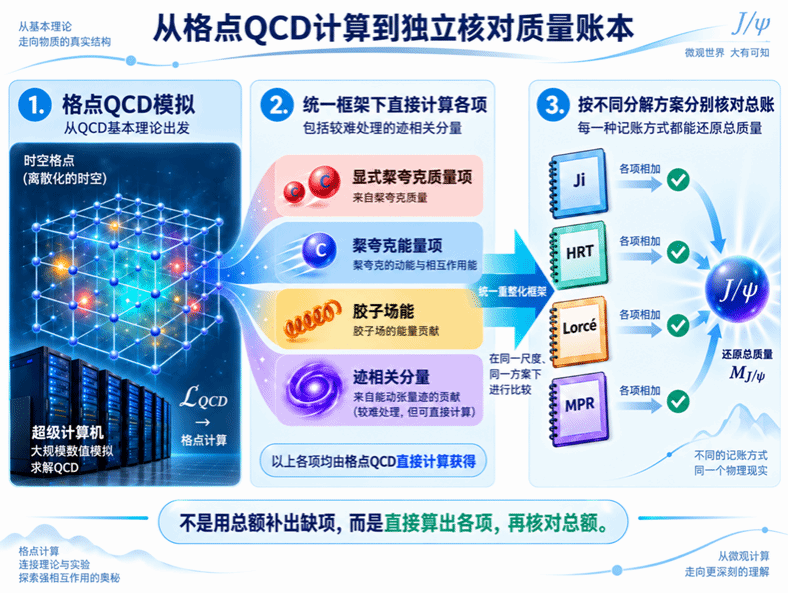
Figure: From lattice QCD calculations to the independent check of the mass ledger.
Under a unified renormalization framework, the researchers directly compute the energy-momentum tensor components needed for the mass-decomposition test — including the hard-to-treat trace-related components — then sum them according to different decomposition schemes and compare the results with the total mass of the corresponding charmonium. The key point: rather than back-deriving the missing terms from the sum rule under test, they compute directly and verify independently.
The results show that, for both charmonia J/ψ and ηc, the “accounts” under the four mass-decomposition schemes — Hatta–Rajan–Tanaka (HRT), Lorcé, Metz–Pasquini–Rodini (MPR), and Ji — all balance within the uncertainties. This does not mean the four schemes give completely identical proportions for each individual term; rather, it means that, according to each scheme’s own definitions, adding up the directly computed terms reproduces the total mass of the corresponding charmonium. This constitutes the first lattice-QCD direct and simultaneous test of multiple energy-density-type and trace-type mass-decomposition sum rules.
What is more interesting is that even for a hadron like J/ψ composed of heavy quarks, the contributions beyond the explicit charm-quark mass term have not retreated into the background. According to the main text and Fig. 3 of the paper, in the Ji decomposition adopted for the figure, the explicit charm-quark mass term of J/ψ accounts for about 58%, the charm-quark energy term about 26%, the gluon field energy about 6%, and the trace-anomaly contribution about 9%. That is, under this bookkeeping method and energy scale, the explicit charm-quark mass term explains only about six-tenths of the mass; the remaining roughly four-tenths is related to the charm-quark energy, the gluon field, and quantum-anomaly effects.
It should be noted that different mass decompositions correspond to different “bookkeeping standards.” The definitions of the individual contributions are not exactly the same across schemes, and the relevant proportions also depend on the renormalization scheme and the energy scale. Therefore, items with similar names in different schemes should not be regarded as the same physical quantity, nor should they be added across schemes; any comparison must simultaneously specify the definitions, the renormalization scheme, and the energy scale. The core test of this work is: after directly computing all the terms within the same renormalization framework, whether each ledger can, according to its own rules, reproduce the total mass.
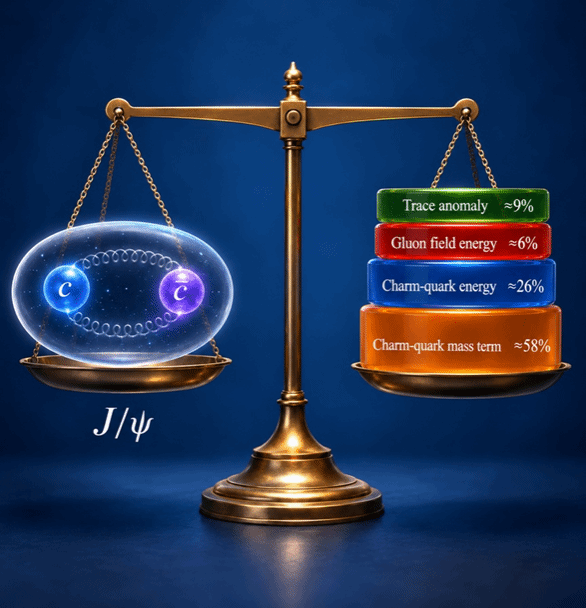
Figure: A popular-science illustration of the Ji decomposition of mass.
The left side of the balance represents the ηc meson, whose principal component is a charm–anticharm quark pair; the right side, from bottom to top, represents the explicit charm-quark mass term, the charm-quark energy term as defined in the Ji decomposition, the gluon field energy, and the trace-anomaly contribution. The charm-quark energy term includes kinetic and interaction contributions. The results correspond to the MS̄ renormalization scheme and the 2 GeV energy scale. The percentages in the figure are approximate roundings based on the central values in the paper’s main text and Fig. 3, and do not show statistical and systematic uncertainties; owing to rounding, the terms are not required to add up strictly to 100%. The sizes of the colored blocks are only illustrative and are not drawn strictly in proportion to the percentages. The figure does not represent the true spatial distribution of these contributions inside the particle.
The significance of this work is not merely that it has “weighed” J/ψ accurately, but that it establishes a method for itemizing the mass of a hadron term by term from the basic theory of QCD and independently checking the total ledger. The paper also reports, for the first time, a lattice-QCD result for the gravitational form factor  at zero momentum transfer; this form factor encodes information related to the trace of the energy-momentum tensor. In the future, this method can be further extended to other hadrons and even atomic nuclei, for studying mass decomposition, spin structure, and gravitational form factors, thereby drawing a more complete picture: how the mass of the matter around us arises from quarks, gluons, and the interactions of the quantum world.
The work was jointly completed by Professor Ding Hengtong, doctoral student Luo Ran of the group, Dennis Bollweg of the Flatiron Institute, and Xiang Gao and Swagato Mukherjee of Brookhaven National Laboratory; Luo Ran and Xiang Gao are the paper’s co-corresponding authors.
The related calculations were carried out on the Nuclear Science Computing Center (NSC³) of Central China Normal University and other computing platforms. The research was supported by the National Natural Science Foundation of China, the National Key R&D Program of China, and other projects.
Paper: Lattice-QCD Validation of Hadron Mass and Trace-Anomaly Decomposition Sum Rules, Physical Review Letters 137, 061901 (2026). DOI: 10.1103/5n46-717z. (APS Journals)