Recently, the international authoritative journal *Physical Review Letters* [Phys. Rev. Lett. 136, 242303 (2026)] published the latest research results from the STAR Collaboration at the Relativistic Heavy-Ion Collider (RHIC): "First observation of deuteron–Λ hyperon correlations at RHIC." In this study, the correlation function between deuterons (d) and Λ hyperons was measured for the first time in gold–gold collisions at a center-of-mass energy of 3.0 GeV, and the strong interaction parameters involving strange quarks were precisely extracted. This provides a novel experimental method for understanding the internal structure of neutron stars and constraining the Λ hyperon binding energy of the hypertriton (³_ΛH). Dr. Xialei Jiang and Ke Mi (Ph.D. graduate of 2025, now a postdoctoral fellow at the University of Chinese Academy of Sciences), supervised by Professor Xiaofeng Luo from the School of Physics, together with Professor Xiaofeng Luo and Professor Nu Xu, are among the major contributing authors of this work. They collaborated with leading contributors from Lawrence Berkeley National Laboratory (Xin Dong, Yu Hu), Tsinghua University (Zhi Qin, Zhigang Xiao), and the University of Chinese Academy of Sciences (Yuanjing Ji) to complete this research.
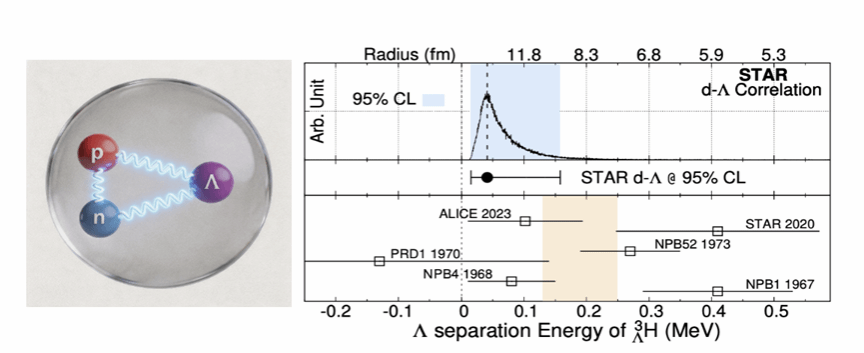
Figure 1 (Left): Schematic diagram of the hypertriton, composed of one proton, one neutron, and one Λ hyperon; (Right): Comparison between the Λ separation energy in the hypertriton calculated from the extracted scattering length and effective range and existing experimental measurements.
Understanding the interaction between hyperons (baryons containing strange quarks) and nucleons is key to revealing the equation of state of matter inside neutron stars. However, due to experimental difficulties and scarce data, precise measurements of hyperon–nucleon interactions have long been a major challenge in nuclear physics. In recent years, femtoscopy has emerged as a powerful tool for addressing this issue. By measuring the momentum correlation function of two particles, one can extract the characteristic parameters of their strong interaction—the scattering length (f) and effective range (d₀). This work, utilizing high-statistics data collected in the fixed-target mode of the STAR experiment, successfully measured the deuteron–Λ correlation function for the first time. A significant correlation enhancement signal was observed in the low relative-momentum region. Through Bayesian inference analysis, the research team decomposed the correlation function into contributions from the particle emission source and the strong interaction, and for the first time separately extracted the scattering parameters for the doublet (D-state, spin 1/2) and quartet (Q-state, spin 3/2) channels of the d–Λ system. The results show that the scattering length in the doublet channel is negative [f₀(D) = −26.1 ± 5.6 fm], which is a necessary condition for the formation of a weakly bound state, while the quartet channel exhibits a weak attractive interaction [f₀(Q) = 18.7 ± 2.8 fm]. In addition, the hypertriton (³_ΛH) is a weakly bound strange nucleus composed of a Λ hyperon and a deuteron, and its Λ separation energy (i.e., binding energy) has long been subject to measurement controversies. This study innovatively used the extracted doublet-channel scattering parameters to inversely deduce the Λ separation energy of the hypertriton via effective-range expansion, yielding a result of 0.12⁺⁰.⁰³ MeV (at 95% confidence level). This result is consistent within errors with the global weighted average of previous experimental data (0.19 ± 0.06 MeV), and demonstrates the great potential of correlation measurements as an independent method for such determinations.
The RHIC-STAR international collaboration consists of more than 700 researchers from 79 institutions across 14 countries. The fixed-target data analysis for the second phase of the STAR Beam Energy Scan (BES-II) is progressing steadily, covering lower collision energies down to 3 GeV from 7.7 GeV. In addition, the CBM experiment at FAIR in Germany, the MPD experiment at NICA in Russia, and the Cooling Storage Ring External-target Experiment (CEE) in China are about to commence operations. Our institute's medium- and high-energy nuclear physics research team will continue to play an important role in these major international facilities, conducting high-level research in areas such as exploring the QCD phase diagram in the high-baryon-density region and the equation of state of nuclear matter.
This work was supported by the National Natural Science Foundation of China and the Ministry of Science and Technology Key R&D Program. The paper was officially published on June 18, 2026.
Article link: https://journals.aps.org/prl/abstract/10.1103/3m26-5y83