From June 5 to 8, 2026, The 1st Central China Center for Nuclear Theory (C3NT) Regional Workshop was successfully held in Changsha. The workshop was jointly organized by Anhui University, Anhui University of Science and Technology, Hunan University, Hunan Normal University, Huazhong University of Science and Technology, Central China Normal University, Henan University, Henan University of Technology, Henan Normal University, University of South China, Central South University, China University of Geosciences (Wuhan), University of Science and Technology of China, and Zhengzhou University, and hosted by the School of Physics and Electronics, Hunan University. Scholars, young faculty members, and graduate student representatives from universities across Central China attended the meeting.
Relying on the regional collaboration platform of C3NT, the workshop aimed to promote exchanges and cooperation among researchers in nuclear theory and particle physics in Central China, consolidate regional research capacity in nuclear physics, and facilitate in-depth discussions on cutting-edge topics in nuclear theory, disciplinary development planning, and cross-institutional collaboration mechanisms. C3NT is hosted by the Institute of Particle Physics at Central China Normal University, focusing on frontier research and academic exchange in nuclear theory, and committed to strengthening the close link between theoretical studies and experimental frontiers.
The workshop featured sessions on nuclear structure, nuclear matter under extreme conditions, hadron physics, nuclear astrophysics and fundamental symmetries, as well as applications of quantum computing and artificial intelligence in nuclear physics. Professor Xin-nian Wang delivered a talk titled Introduction to C3NT, presenting the center’s founding background, research directions, and vision for regional collaboration. Professor Lingyun Dai introduced the development of the High Energy Physics team at Hunan University. Scholars from Anhui University of Science and Technology, Hunan Normal University, Huazhong University of Science and Technology, Central China Normal University, University of South China, Central South University, China University of Geosciences (Wuhan), University of Science and Technology of China, and Zhengzhou University gave thematic reports.
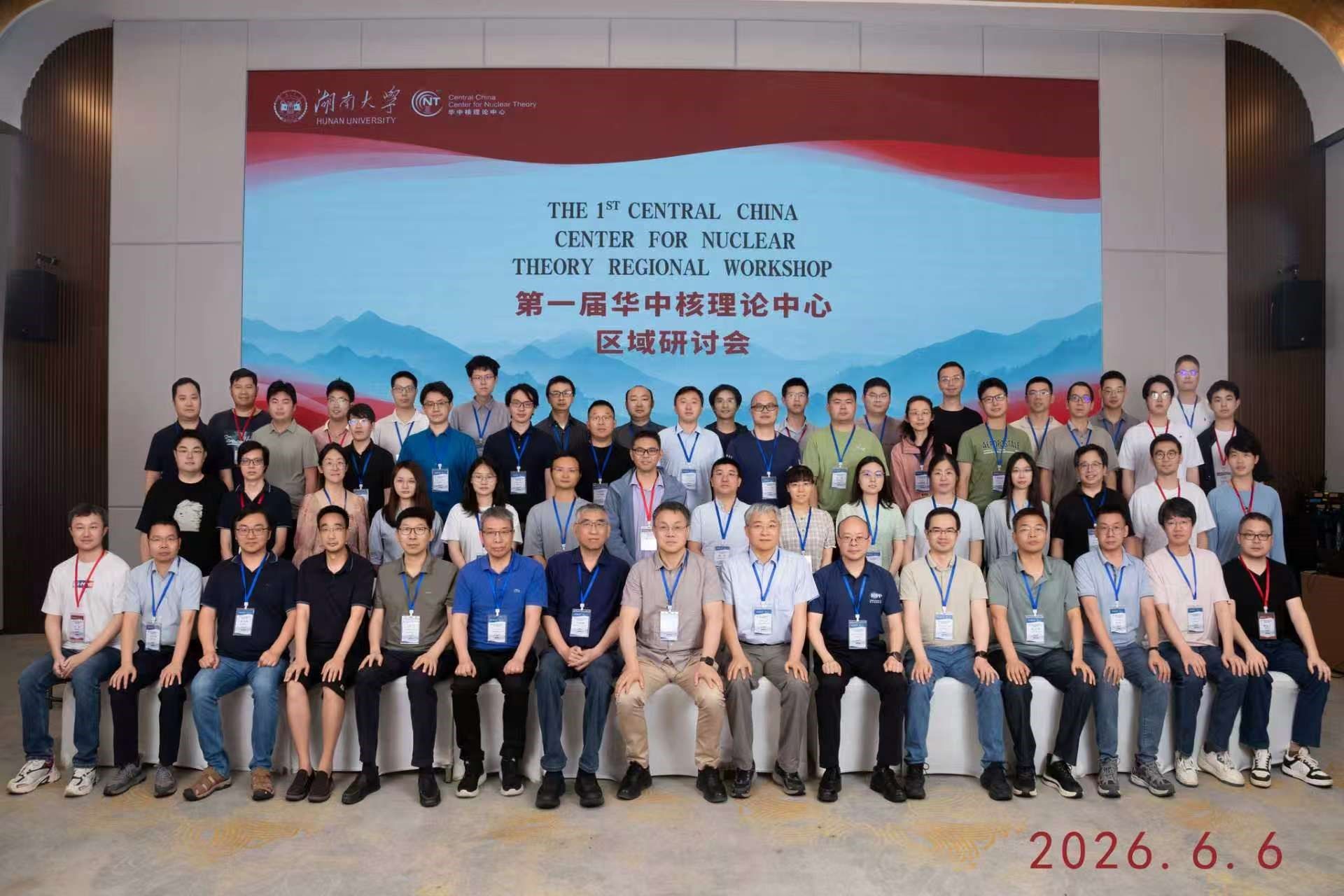
Participants engaged in extensive discussions on frontier topics including effective field theory for dark matter–nucleus scattering, meson spin alignment, nucleon sea quark structure, radiative decays of hidden-charm pentaquark molecular states, jet energy correlations in heavy-ion collisions, D-meson production mechanisms, gravitational wave signals from dark QCD phase transitions, and applications of automatic differentiation and generative models in high-energy nuclear physics. The workshop also included sessions for introducing regional research teams and discussing future collaborations, with in-depth conversations on building a nuclear theory research workforce in Central China, training young talent, organizing joint academic activities, and establishing cross-institutional cooperation mechanisms.
The successful convening of this workshop marks an important step for C3NT in advancing regional academic exchange and collaboration. Moving forward, C3NT will continue to serve as an open academic platform, working with relevant universities and research institutions in Central China to organize a series of workshops and young scholar exchange programs focused on frontier topics in nuclear theory, so as to support disciplinary development and high-level scientific cooperation across the region.
Correspondent: Tan Luo
Proofreader: Lingyun Dai