Recently, the LHCb experimental team of the School of Physical Science and Technology, Central China Normal University, has made important progress in heavy flavor physics research. The research paper Precise Measurement of CP Violation in  Decays and Search for the Rare Decay
  , led by Professor Yin Hang and his graduate students, was published in Physical Review Letters, the top international academic journal in physics, on April 21, 2026.
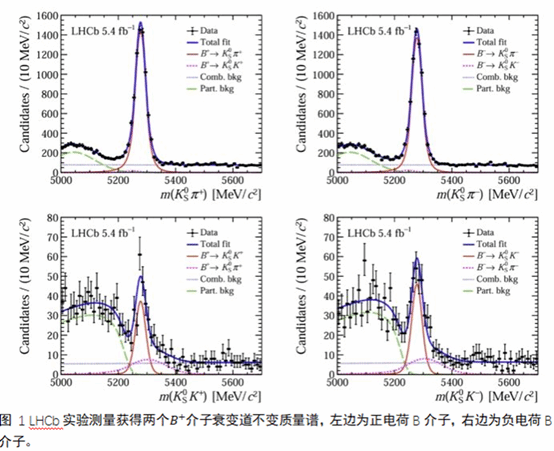
Figure 1: Invariant mass spectra of two B⁺ meson decay channels measured by the LHCb experiment. Left: positively charged B meson; Right: negatively charged B meson.
This study has performed a precise measurement of the Charge-Parity (CP) violation parameters in  decay processes, achieving the most precise results in the world to date. This achievement not only provides key experimental evidence for precisely testing the Standard Model of particle physics and searching for new sources of CP violation, but also is expected to offer important experimental support for resolving the long-standing "Kπ puzzle" in heavy flavor physics.
In the Standard Model of particle physics, charmless two-body hadronic decays of B mesons are important laboratories for studying CP violation. For a long time, the large difference in CP violation observed experimentally between different  decay channels (the famous "Kπ puzzle") has attracted great attention from theoretical physicists. This research focuses on analyzing two decay processes,
  and
and  , corresponding to
  and
and  quark transitions respectively. Within the framework of the Standard Model, the
  process is dominated by gluon penguin diagrams, and its CP violation effect is theoretically predicted to be close to zero. Different theoretical methods (such as pQCD and QCDF) predict opposite signs for CP violation in the
  process. Therefore, precise measurements of the CP violation parameters of these two processes are of great significance for discriminating QCD theoretical calculation methods, testing the Standard Model, and searching for signs of new physics.
Based on the massive data collected by the LHCb experiment from 2016 to 2018, this study successfully selected pure signal events from complex collision backgrounds using advanced particle identification systems, vertex detectors, and multivariate analysis methods such as gradient boosting decision trees (as shown in the figure). Based on these events, the team obtained the world's most precise measurements of the CP violation parameters of these two processes, with the precision improved by about twice compared with the early results of the LHCb experiment. Meanwhile, the study also searched for the "pure annihilation" rare decay  for the first time, and set a strict upper limit on the branching ratio of this process.
The results show that the experimentally measured CP violation parameters deviate from some theoretical predictions by about 2 to 3 standard deviations. This may reflect the complexity of strong interaction dynamics or indicate the existence of new physics. With the accumulation of more experimental data in the new run of the LHC, the LHCb experiment is expected to further improve the measurement precision, provide a final explanation for the "Kπ puzzle", and search for new clues beyond the Standard Model in the field of heavy quark physics.
In the past two years, Professors Xie Yuehong and Yin Hang have led the particle physics experimental team of Central China Normal University to make continuous progress in the research of heavy flavor physics and CP violation. They have achieved a series of results including the first observation of baryon CP violation, the first evidence of direct CP violation in bottom hadron to charmonium processes, and the discovery of the rare process  . Relevant work has been published in renowned journals such as Nature and Physical Review Letters.
This research was supervised by Professor Yin Hang of Central China Normal University, and doctoral student Hou Ruiwen was responsible for the main data analysis and served as the corresponding author of the paper. The research was supported by the Key Program of the Ministry of Science and Technology. The paper is co-authored by all members of the LHCb Collaboration, and the authors are listed in alphabetical order following the international convention in high-energy physics.
华大物院党委融媒体中心
华大物院团委宣传中心
通讯员|王 棣
责 编|程雍棋
审 校|赵蕴杰