In high-energy heavy-ion collision experiments, matter is heated to extremely high temperatures, forming a new state of matter governed by the strong interaction—the Quark-Gluon Plasma (QGP). Probing the spatial and temporal structure of the strong interaction field (abbreviated as "strong field") inside the QGP has long been a central challenge in the field of high-energy nuclear physics.
Recently, a research team comprising Dr. Xinli Sheng (former postdoctoral fellow at Central China Normal University, now at the University of Florence, Italy), Dr. Xiangyu Wu (PhD graduate of Central China Normal University, now at McGill University, Canada), Professor Dirk Rischke (Goethe University Frankfurt), and Professor Xin-Nian Wang (Central China Normal University) proposed a new observable—"net hyperon spin correlation." This observable effectively filters out the hydrodynamic background, providing, for the first time, a clear experimental pathway to quantitatively detect the strength of strong field fluctuations within the QGP. The related research was published as the cover article in a recent issue of Physical Review Letters. (Related paper information: https://doi.org/10.1103/z5kk-98my)
As early as 2004, Professors Xin-Nian Wang and Zuo-Tang Liang (Shandong University) pioneeringly predicted that a portion of the immense orbital angular momentum generated in non-central heavy-ion collisions would be transferred to the QGP, endowing it with a substantial overall vorticity. Through the spin-orbit coupling effect, quarks within the QGP would become globally polarized along the direction of the system's angular momentum. This phenomenon of "fluid vorticity-induced polarization" was subsequently confirmed by the STAR experiment through observations of hyperon polarization in 2017 and vector meson spin alignment in 2023.
Although the macroscopic rotation mechanism is well-established, the signal magnitude for vector meson spin alignment (which depends on the spin correlation between its constituent quark and antiquark) observed experimentally at the microscopic quark level is significantly larger than theoretical predictions based solely on classical fluid vorticity or electromagnetic field mechanisms. To explain this anomaly, some members of the team had previously proposed a hypothesis: in addition to macroscopic fluid vorticity, the strong interaction field inside the QGP also exhibits intense, short-range microscopic fluctuations. These fluctuations would induce additional spin correlations among spatially close quarks, leading to the experimentally observed vector meson spin alignment. However, because the effects of strong field fluctuations and hydrodynamic effects are intertwined, whether this mechanism is dominant has remained a subject of theoretical and experimental debate.
To rigorously test the "strong field fluctuation" mechanism, the research team turned their attention to hyperons. Since hyperon spin polarization and vector meson spin alignment share a common physical origin at the quark level, hyperons should similarly exhibit spin correlations dominated by strong field fluctuations.
Based on relativistic 3+1 dimensional viscous fluid dynamics simulations and a quark combination model, the team performed systematic quantitative calculations of hyperon spin correlations and discovered a unique phenomenon: the effect on spin correlations is nearly identical for pairs of the same type of hyperons (Λ-Λ) and anti-hyperons (anti-Λ-anti-Λ). In contrast, for pairs of different types (Λ-anti-Λ), the magnitude of the spin correlation is the same, but the sign is opposite.
Leveraging this significant difference in physical characteristics, the team innovatively constructed a new experimental observable—the net spin correlation (defined as the difference between same-type hyperon spin correlation and different-type hyperon spin correlation). This approach, akin to differential measurement, is highly ingenious: subtracting the two cancels out the dominant fluid vorticity effects (the background), thereby isolating the microscopic "strong field fluctuation effect" as a clean signal. This provides solid theoretical guidance for future experimental verification of the origin of spin correlations and for detecting strong field fluctuations in collider experiments.
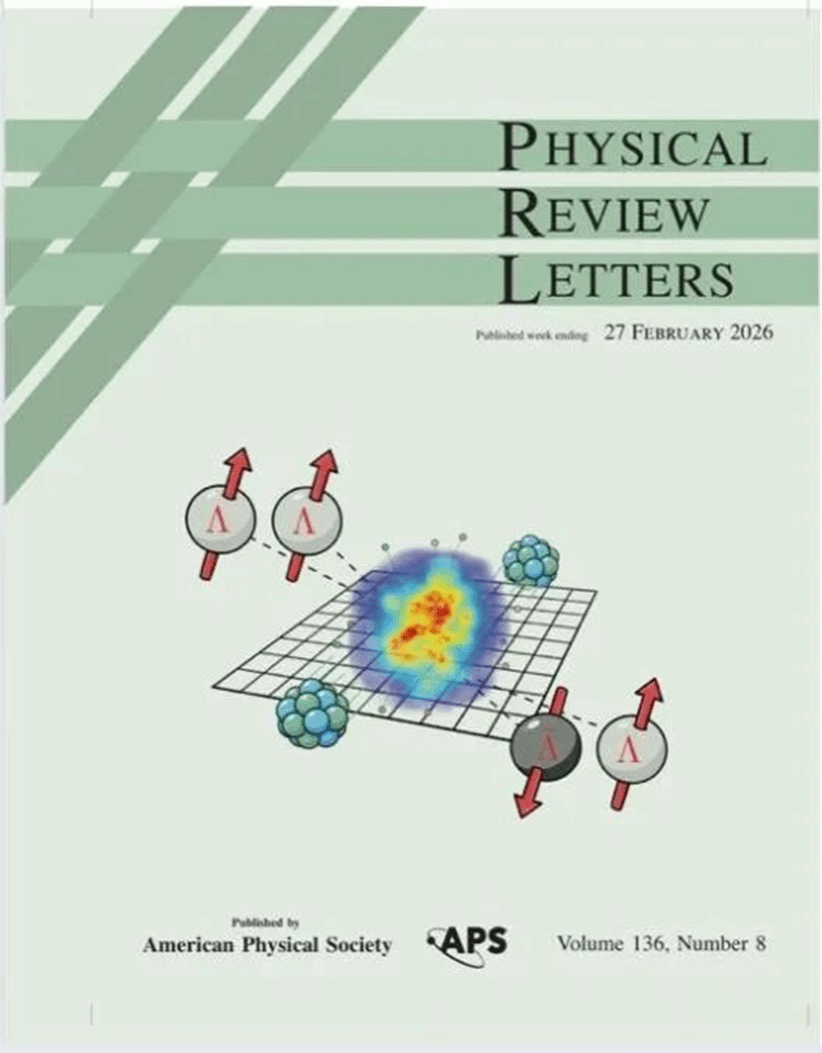
Schematic of the Physical Review Letters cover: Strong field fluctuations in the Quark-Gluon Plasma produced in heavy-ion collisions lead to parallel spin alignment of Λ-Λ hyperons (top left) and anti-parallel spin alignment of Λ-anti-Λ hyperons (bottom right).
华大物院党委融媒体中心
华大物院团委宣传中心
通讯员|盛欣力
责 编|陈 爽
审 校|秦广友