From December 19 to 22, 2025, the School of Physical Science and Technology hosted the "Workshop on RHIC Energy Scan and Transport Methods for Extreme Nuclear Matter." The conference engaged in in-depth discussions on frontier issues in heavy-ion collision physics, establishing a significant academic platform to promote the integrated development of theoretical and experimental research on extreme nuclear matter transport.
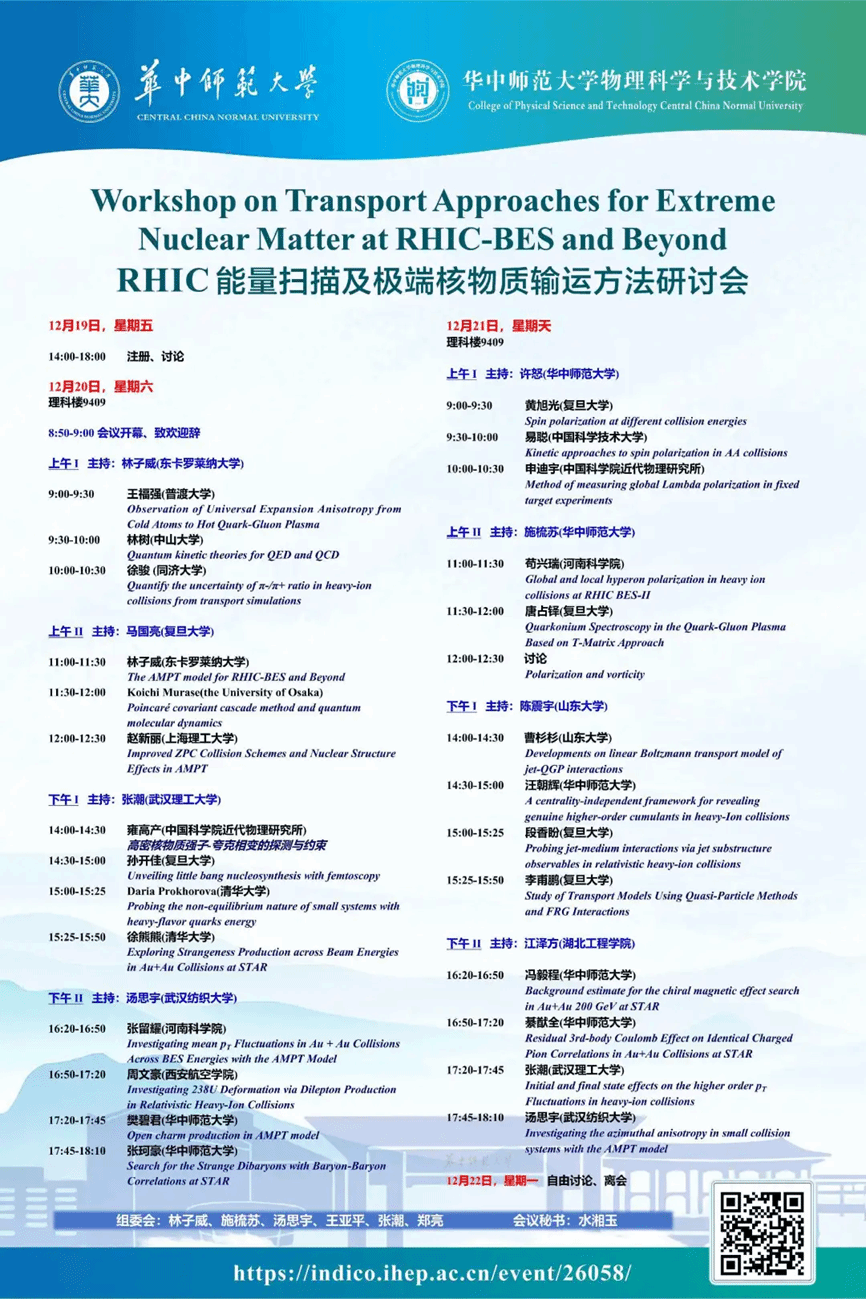
This workshop focused on the RHIC energy scan and related cutting-edge physics issues, delving deeply into core topics such as the properties of quark-gluon plasma, the phase transition mechanisms of high-density nuclear matter, and spin polarization effects. The participating experts unanimously agreed that deep integration between theory and experiment is a crucial pathway for driving continuous innovation in heavy-ion collision physics research, and this conference provided valuable support for academic exchange and collaboration. Scholars and experts from numerous renowned universities and research institutions, both domestic and international, attended this academic event. Through various formats including keynote speeches, specialized seminars, and group discussions, the conference fostered deep interdisciplinary interactions and innovative integration among different research fields. Participants engaged in lively discussions on topics such as recent advancements in transport methods for extreme nuclear matter, the interpretation and prediction of experimental phenomena by theoretical simulations, and the planning of future research directions, laying a solid foundation for subsequent collaborative research. The workshop organizing committee consisted of Lin Ziwei, Shi Shusu, Tang Siyu, Wang Yaping, Zhang Chao, Zheng Liang, and others. The conference provided a valuable communication platform for scholars in related fields. Attendees believed that this workshop not only advanced the theoretical development and experimental verification of transport methods for extreme nuclear matter but also created an excellent opportunity for deeper collaboration among peers both in China and abroad.
Looking ahead, the participating experts expressed their commitment to continue strengthening collaborative innovation between theoretical and experimental teams. They aim to further deepen the understanding of the properties of extreme nuclear matter, actively explore the physical laws of quantum chromodynamics under extreme conditions, jointly promote progress in China's heavy-ion collision physics research, and contribute more wisdom and strength to the development of related disciplines.
END
华大物院党委融媒体中心
华大物院团委宣传中心
通讯员|王家珂
责 编|陈心蕾
审 校|施梳苏