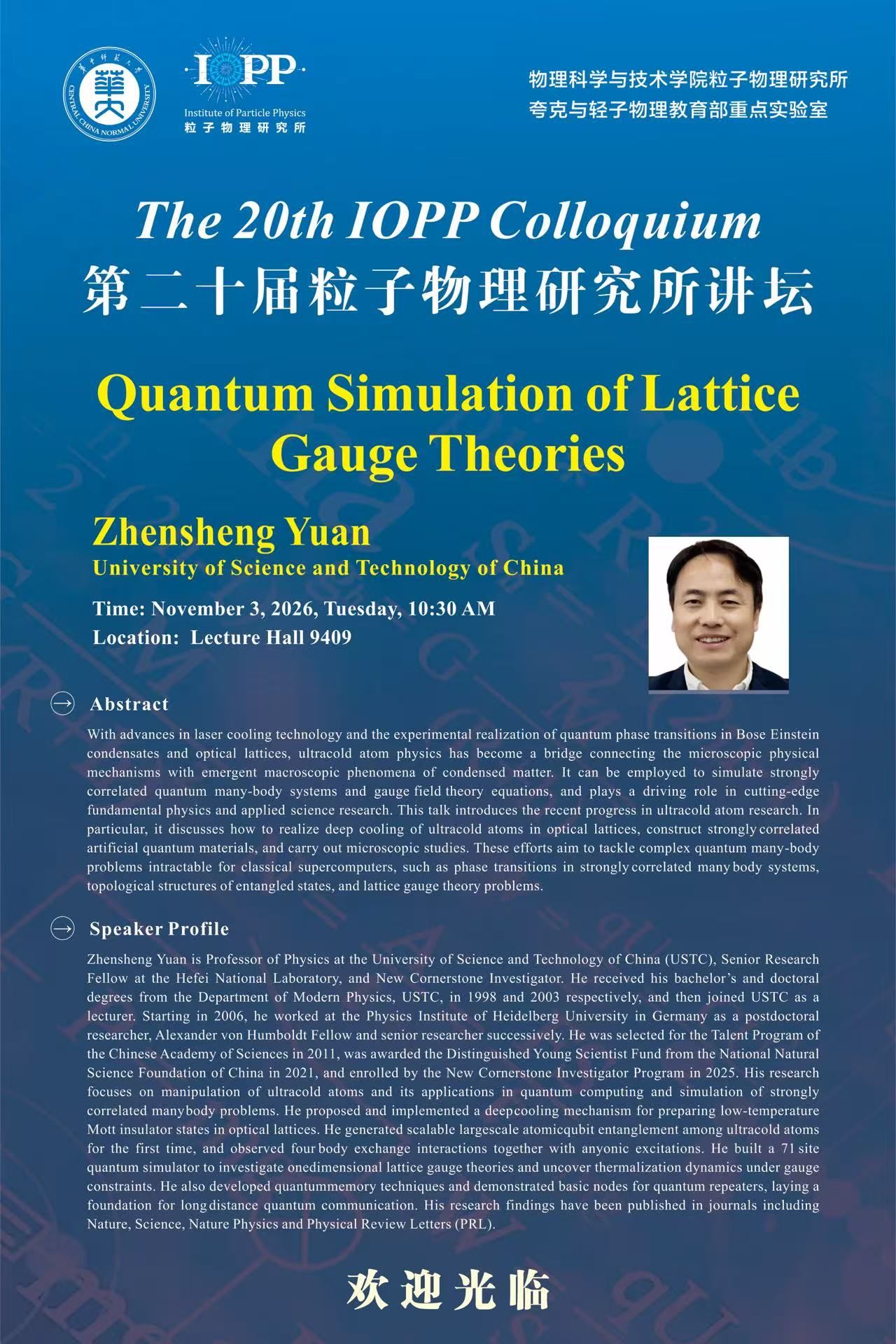
Speaker: Zhensheng Yuan, University of Science and Technology of China
Time: November 3, 2026,Tuesday,10:30 am
Location: Room 9409
Abstract:
With advances in laser cooling technology and the experimental realization of quantum phase transitions in Bose Einstein condensates and optical lattices, ultracold atom physics has become a bridge connecting the microscopic physical mechanisms with emergent macroscopic phenomena of condensed matter. It can be employed to simulate strongly correlated quantum many body systems and gauge field theory equations, and plays a driving role in cutting edge fundamental physics and applied science research. This talk introduces the recent progress in ultracold atom research. In particular, it discusses how to realize deep cooling of ultracold atoms in optical lattices, construct strongly correlated artificial quantum materials, and carry out microscopic studies. These efforts aim to tackle complex quantum many body problems intractable for classical supercomputers, such as phase transitions in strongly correlated many body systems, topological structures of entangled states, and lattice gauge theory problems.
Speaker Profile:
Zhensheng Yuan is Professor of Physics at the University of Science and Technology of China (USTC), Senior Research Fellow at the Hefei National Laboratory, and New Cornerstone Investigator. He received his bachelor’s and doctoral degrees from the Department of Modern Physics, USTC, in 1998 and 2003 respectively, and then joined USTC as a lecturer. Starting in 2006, he worked at the Physics Institute of Heidelberg University in Germany as a postdoctoral researcher, Alexander von Humboldt Fellow and senior researcher successively. He was selected for the Talent Program of the Chinese Academy of Sciences in 2011, was awarded the Distinguished Young Scientist Fund from the National Natural Science Foundation of China in 2021, and enrolled by the New Cornerstone Investigator Program in 2025. His research focuses on manipulation of ultracold atoms and its applications in quantum computing and simulation of strongly correlated many body problems. He proposed and implemented a deep cooling mechanism for preparing low-temperature Mott insulator states in optical lattices. He generated scalable large scale atomic qubit entanglement among ultracold atoms for the first time, and observed four body exchange interactions together with anyonic excitations. He built a 71 site quantum simulator to investigate one dimensional lattice gauge theories and uncover thermalization dynamics under gauge constraints. He also developed quantum memory techniques and demonstrated basic nodes for quantum repeaters, laying a foundation for long distance quantum communication. His research findings have been published in journals including Nature, Science, Nature Physics and Physical Review Letters (PRL).