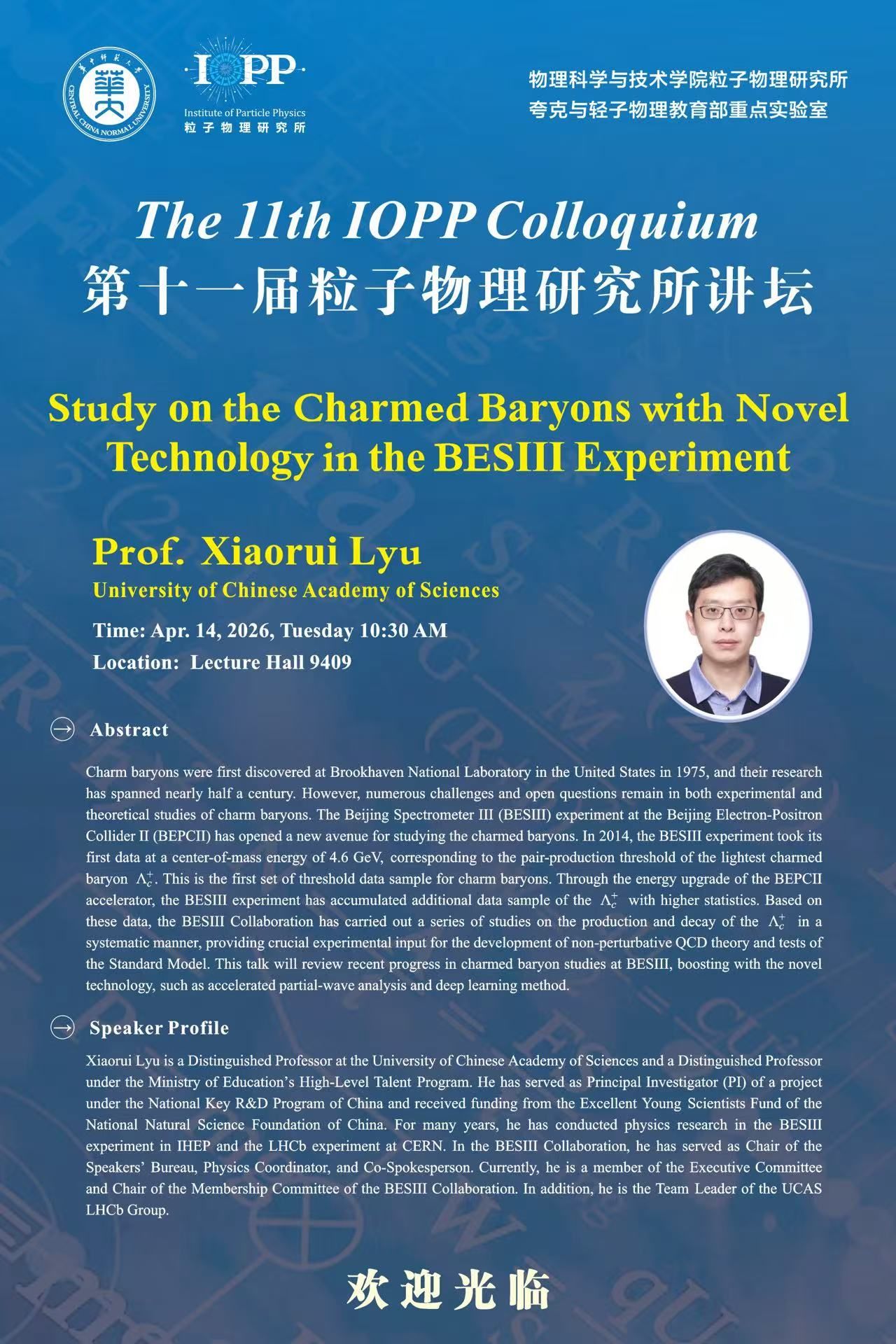
Speaker: Prof. Xiaorui Lyu, University of Chinese Academy of Scieces
Time: Apr. 14, 2026, Tuesday 10:30 AM
Location: Lecture Hall 9409
Abstract:
Charm baryons were first discovered at Brookhaven National Laboratory in the United States in 1975, and their research has spanned nearly half a century. However, numerous challenges and open questions remain in both experimental and theoretical studies of charm baryons. The Beijing Spectrometer III (BESIII) experiment at the Beijing Electron-Positron Collider II (BEPCII) has opened a new avenue for studying the charmed baryons. In 2014, the BESIII experiment took its first data at a center-of-mass energy of 4.6 GeV, corresponding to the pair-production threshold of the lightest charmed baryon "Λ" _"c" ^"+" . This is the first set of threshold data sample for charm baryons. Through the energy upgrade of the BEPCII accelerator, the BESIII experiment has accumulated additional data sample of the "Λ" _"c" ^"+" with higher statistics. Based on these data, the BESIII Collaboration has carried out a series of studies on the production and decay of the "Λ" _"c" ^"+" in a systematic manner, providing crucial experimental input for the development of non-perturbative QCD theory and tests of the Standard Model. This talk will review recent progress in charmed baryon studies at BESIII, boosting with the novel technology, such as accelerated partial-wave analysis and deep learning method.
Speaker Profile:
Xiaorui Lyu is a Distinguished Professor at the University of Chinese Academy of Sciences and a Distinguished Professor under the Ministry of Education’s High-Level Talent Program. He has served as Principal Investigator (PI) of a project under the National Key R&D Program of China and received funding from the Excellent Young Scientists Fund of the National Natural Science Foundation of China. For many years, he has conducted physics research in the BESIII experiment in IHEP and the LHCb experiment at CERN. In the BESIII Collaboration, he has served as Chair of the Speakers’ Bureau, Physics Coordinator, and Co-Spokesperson. Currently, he is a member of the Executive Committee and Chair of the Membership Committee of the BESIII Collaboration. In addition, he is the Team Leader of the UCAS LHCb Group.
PPT or PDf file download:/doc/LYUXR_BESIIILc2026.pdf