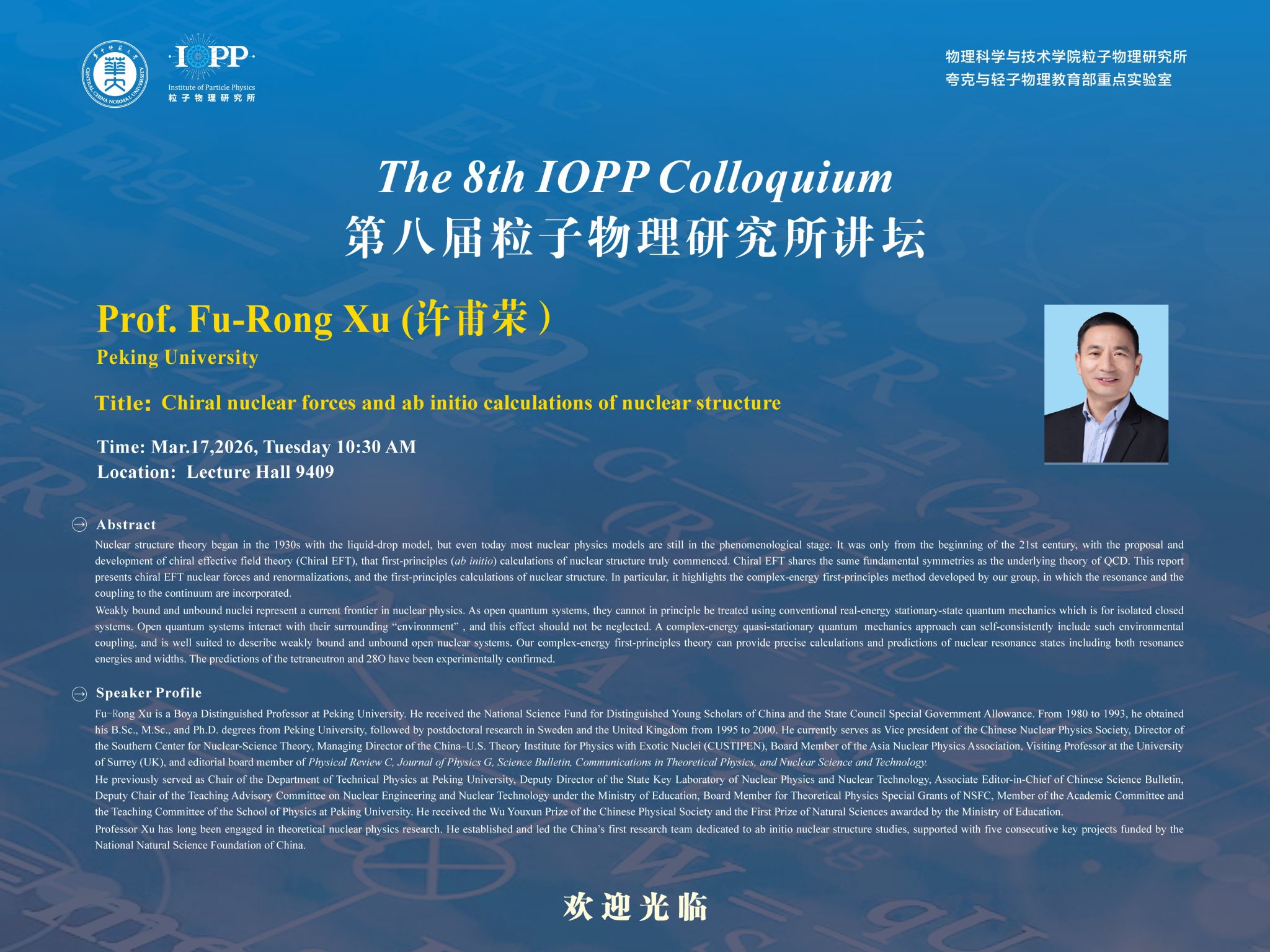
Speaker: Prof. Fu-Rong Xu (许甫荣), Peking University
Time: Mar.17,2026, Tuesday 10:30 AM
Location: Lecture Hall 9409
Abstract:
Nuclear structure theory began in the 1930s with the liquid-drop model, but even today most nuclear physics models are still in the phenomenological stage. It was only from the beginning of the 21st century, with the proposal and development of chiral effective field theory (Chiral EFT), that first-principles (ab initio) calculations of nuclear structure truly commenced. Chiral EFT shares the same fundamental symmetries as the underlying theory of QCD. This report presents chiral EFT nuclear forces and renormalizations, and the first-principles calculations of nuclear structure. In particular, it highlights the complex-energy first-principles method developed by our group, in which the resonance and the coupling to the continuum are incorporated.
Weakly bound and unbound nuclei represent a current frontier in nuclear physics. As open quantum systems, they cannot in principle be treated using conventional real-energy stationary-state quantum mechanics which is for isolated closed systems. Open quantum systems interact with their surrounding “environment” , and this effect should not be neglected. A complex-energy quasi-stationary quantum mechanics approach can self-consistently include such environmental coupling, and is well suited to describe weakly bound and unbound open nuclear systems. Our complex-energy first-principles theory can provide precise calculations and predictions of nuclear resonance states including both resonance energies and widths. The predictions of the tetraneutron and 28O have been experimentally confirmed.
Speaker Profile:
Fu-Rong Xu is a Boya Distinguished Professor at Peking University. He received the National Science Fund for Distinguished Young Scholars of China and the State Council Special Government Allowance. From 1980 to 1993, he obtained his B.Sc., M.Sc., and Ph.D. degrees from Peking University, followed by postdoctoral research in Sweden and the United Kingdom from 1995 to 2000. He currently serves as Vice president of the Chinese Nuclear Physics Society, Director of the Southern Center for Nuclear-Science Theory, Managing Director of the China–U.S. Theory Institute for Physics with Exotic Nuclei (CUSTIPEN), Board. 3 Member of the Asia Nuclear Physics Association, Visiting Professor at the University of Surrey (UK), and editorial board member of Physical Review C, Journal of Physics G, Science Bulletin, Communications in Theoretical Physics, and Nuclear Science and Technology.
He previously served as Chair of the Department of Technical Physics at Peking University, Deputy Director of the State Key Laboratory of Nuclear Physics and Nuclear Technology, Associate Editor-in-Chief of Chinese Science Bulletin, Deputy Chair of the Teaching Advisory Committee on Nuclear Engineering and Nuclear Technology under the Ministry of Education, Board Member for Theoretical Physics Special Grants of NSFC, Member of the Academic Committee and the Teaching Committee of the School of Physics at Peking University. He received the Wu Youxun Prize of the Chinese Physical Society and the First Prize of Natural Sciences awarded by the Ministry of Education.
Professor Xu has long been engaged in theoretical nuclear physics research. He established and led the China’s first research team dedicated to ab initio nuclear structure studies, supported with five consecutive key projects funded by the National Natural Science Foundation of China.
PPT or PDF file download:/doc/huashi_hejiegoudiyixingyuanliyanjiu.pptx