Recently, the international large-scale heavy-ion experiment STAR Collaboration has made significant progress in the study of the fundamental properties of strongly interacting matter. In collaboration with Kent State University, Brookhaven National Laboratory, the University of Science and Technology of China, and other institutions, Huazhong Normal University utilized high-energy nuclear collision data from the Relativistic Heavy Ion Collider (RHIC) at Brookhaven National Laboratory to conduct experimental research on a long-standing fundamental physics question: "Is the baryon number carried by quarks or by gluons?" The results provide important experimental evidence that the baryon number is primarily carried and transported through a special Y-shaped "gluon junction" (also called a baryon junction) structure.
The related research findings, titled "Tracking the baryon number with nuclear collisions," were published online in the journal *Science* in the early hours of August 14, 2026. Professor Xiaofeng Luo from the School of Physics and Technology at Huazhong Normal University and his doctoral student Hui Liu (now a faculty member at Huzhou Normal University) are among the major contributors to this work.
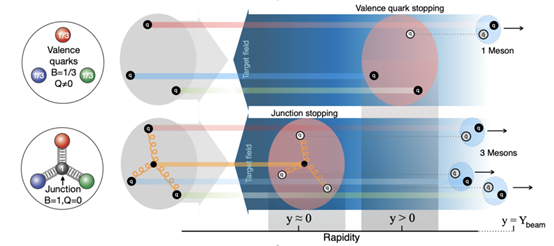
The carrier and transport mechanism of the baryon number
Left panel: Schematic diagram of two possible carriers of the baryon number
(upper: valence quarks; lower: baryon junction).
Right panel: Schematic diagram of baryon number transport from beam rapidity (y=Y_beam) to mid-rapidity region in high-energy collisions, where the baryon number is carried either by valence quarks (upper) or by the baryon junction (lower). The non-stopped valence quarks (solid black circles) can form mesons near the beam rapidity. Hollow circles represent newly produced quarks and antiquarks in the collision.
Who carries the baryon number?
Protons and neutrons are the fundamental particles that constitute atomic nuclei and all visible matter in the universe. In the traditional naive quark model, a proton or neutron has a baryon number of 1, which is generally considered to be equally distributed among its three internal valence quarks, i.e., each valence quark carries 1/3 of the baryon number. However, Quantum Chromodynamics (QCD) tells us that the real internal structure of a proton is far more complex than just three valence quarks. Besides valence quarks, there exist a large number of sea quarks that are constantly being created and annihilated, as well as gluons responsible for transmitting the strong force. As early as the 1970s, theoretical physicists proposed that the three valence quarks might be connected through a special Y-shaped gluon topological structure, known as the "baryon junction" or "gluon junction." In 1996, theoretical studies further suggested that what truly labels and carries the baryon number might not be the three valence quarks themselves, but rather this gluonic topological structure connecting them. However, for a long time, experimentally distinguishing between these two pictures has been a highly challenging problem.
"Tracking" the baryon number using isobaric nuclear collisions
The STAR Collaboration adopted an innovative experimental strategy this time. The researchers analyzed data from collisions of ruthenium-96 (Ru+Ru) and zirconium-96 (Zr+Zr) isobars at RHIC, with a center-of-mass energy of 200 GeV per nucleon pair. Ru and Zr have the same mass number but different proton numbers, hence different electric charges, while their total baryon numbers are identical. This unique property allows scientists to directly compare charge transport and baryon number transport.
Valence quarks carry both electric charge and baryon number. If the baryon number moved entirely together with the valence quarks, the transport of baryon number and electric charge in nuclear collisions should exhibit a relatively close correspondence. However, the experimental results show that the observed baryon number transport in the central rapidity region is significantly stronger than the valence quark transport inferred from charge transport. This result implies that the observed baryon number cannot be simply explained by "stopped" valence quarks. The STAR Collaboration further studied photonuclear reactions produced by photons interacting with gold nuclei. In such reactions, the incoming photon itself carries no baryon number, thus providing a cleaner experimental environment for studying how baryon number is transported over long distances from the incident nucleus to the mid-rapidity region. The measured net proton rapidity distribution also agrees with theoretical expectations that include the baryon junction mechanism. These two mutually independent experimental observations corroborate each other, providing strong support for the physical picture that the baryon number is mainly carried and transported by the Y-shaped topological structure formed by gluons.
Huazhong Normal University team provides important experimental foundation for net baryon number reconstruction
In this study, accurately obtaining the experimental "baryon number" is one of the key steps. The STAR detector can precisely measure charged protons and antiprotons, but neutrons and antineutrons are uncharged and difficult to measure directly in the STAR central detector. Since neutrons account for a considerable proportion of the baryons produced in collisions, achieving precise baryon number measurement requires a reliable determination of the yields of neutrons and antineutrons. To address this issue, the STAR Collaboration utilized the measured yields of protons, antiprotons, deuterons, and antideuterons in Ru+Ru and Zr+Zr collisions, combined with light-nucleus coalescence relations and contributions from weak decays of hadrons, to reconstruct the yields of neutrons and antineutrons. The paper explicitly uses the measured antideuteron-to-deuteron yield ratio to constrain the production of primary neutrons and antineutrons, thereby enabling a reliable estimation of the net baryon number at mid-rapidity.
Dr. Hui Liu, during her doctoral studies at Huazhong Normal University under the supervision of Professor Xiaofeng Luo, conducted long-term research on light-nucleus production in the RHIC-STAR experiment and completed systematic measurements of protons, deuterons, and other light nuclei in 200 GeV Ru+Ru and Zr+Zr isobaric collisions. The related measurements of deuterons and antideuterons provided crucial experimental input for the reconstruction of neutron, antineutron, and net baryon numbers in this work.
After completing her Ph.D., Dr. Hui Liu has continued her research on relativistic heavy-ion collisions and QCD matter. She is currently a faculty member at Huzhou Normal University and remains an active member of the STAR Collaboration, continuing her related scientific work.
Deepening the understanding of the strong interaction and the fundamental structure of matter
Baryon number conservation is one of the most fundamental laws in particle physics. Since the early universe formed matter, the baryon number has exhibited a high degree of stability within known low-energy processes and the framework of the Standard Model. The extreme stability of the proton and the long-term existence of atomic nuclei composed of protons and neutrons are closely related to this fundamental property.
The results of this STAR experiment indicate that describing baryons such as protons and neutrons merely as simple combinations of three valence quarks may be incomplete. The gluon field connecting the quarks and its non-perturbative topological structure may play a role in defining and transmitting the fundamental quantum numbers of baryons. This discovery advances our understanding of hadronic internal structure from the level of "quark composition" further to the level of "quark–gluon global topological structure," and also provides new experimental evidence for understanding non-perturbative QCD properties, baryon formation mechanisms, and baryon number transport in high-energy nuclear collisions.
The RHIC-STAR experimental international collaboration comprises over 700 researchers from 79 institutions across 14 countries. This achievement is also one of the important results from the RHIC and STAR experiments over more than twenty years of research on the fundamental properties of strongly interacting matter. Huazhong Normal University is a key member institution of the STAR international collaboration. In recent years, the STAR experimental team at the School of Physics and Technology has continuously conducted research on frontier directions such as the QCD phase structure and critical point, high-baryon-density nuclear matter, conserved charge fluctuations, light-nucleus and hypernucleus production, particle correlations and hadronic interactions, strange hadron production, and collective flow. They have actively participated in major international scientific collaborations including RHIC-STAR, LHC-ALICE/LHCb, FAIR-CBM, and NICA-MPD, achieving a series of important progress in the study of the properties of strongly interacting matter and the QCD phase structure. This work was supported by the National Natural Science Foundation of China and projects from the Ministry of Science and Technology.
Paper Information:
STAR Collaboration, Tracking the baryon number with nuclear collisions, *Science* (2026).
Article link: https://www.science.org/doi/10.1126/science.ads5962
END
华大物院党委融媒体中心
华大物院团委宣传中心
通讯员|王 棣
责 编|张思涵
审 校|赵蕴杰