Recently, the international top academic journal "Nature" published a major physical breakthrough - led by the University of Chinese Academy of Sciences in collaboration with research teams from Guangxi University, Central China Normal University, and other universities, the "Migdal effect" predicted by Soviet scientists more than 80 years ago was experimentally observed directly for the first time. This achievement provides crucial support for breaking through the threshold bottleneck in the detection of light dark matter. The core hardware for achieving this breakthrough, the pixel readout chip Topmetal-II, was independently developed by the PLAC Laboratory at Central China Normal University. Its ultra-high sensitivity and precise detection performance have become the core technical cornerstone of the experimental success.
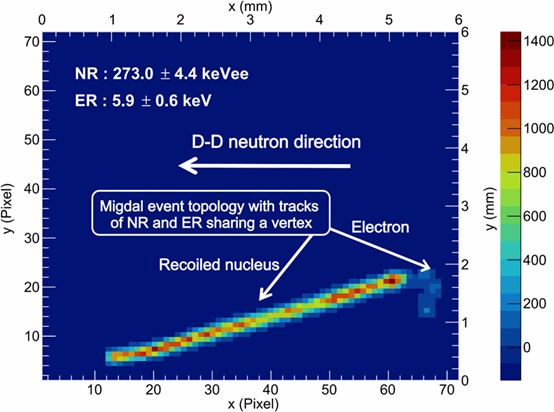
An event of Migdal effect recorded in experimental observations
The Migdal effect, proposed by Soviet physicist Arkady Migdal in 1939, describes the physical process where energy is transferred to the valence electrons through electric field changes during the recoil of the atomic nucleus, forming a "co-incident" charged track. This effect is considered a crucial path to break through the detection threshold of light dark matter. However, the long-term lack of direct experimental verification of this effect in neutral particle collisions has become a key bottleneck restricting related dark matter detection research.
The core challenge of this experiment is to accurately capture the faint co-vertex tracks of "atomic nucleus recoil-Migdal electrons". The Topmetal-II pixel readout chip developed by the PLAC Laboratory of Central China Normal University provides a crucial signal readout solution for the experiment with its core advantages of low noise (equivalent noise charge of only 13.9 e⁻), high position resolution (200 μm), and wide energy detection range. As the "signal capture core" of the ultra-sensitive detection device, this chip can convert the faint charge signals in the gas detector into clear digital tracks, accurately distinguish between atomic nucleus recoil and electron recoil signals, and successfully identify scarce Migdal events from complex backgrounds.
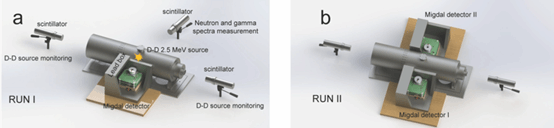
Compact D-D neutron generator, detector, and experimental setup: "Microstructure gas detector + pixel readout chip" detector system
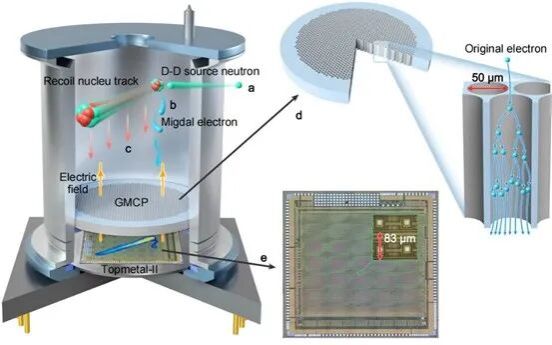
As the core research and development achievement of the PLAC Laboratory at Central China Normal University, the Topmetal series of chips has long focused on tackling "bottleneck" technologies in the field of high-energy physics detection, and has formed a complete technical system from chip design, tape-out verification to system integration. The Topmetal-II pixel readout chip captures and transmits weak signals in real time through a high-resolution pixel array, and combines specialized data processing algorithms to select six clear Migdal candidate events from nearly one million recorded events. The existence of this effect is confirmed with statistical significance of five standard deviations. The measured ratio of Migdal cross section to nuclear recoil cross section is highly consistent with theoretical predictions. The successful application of this chip in the observation of the Migdal effect not only verifies its reliability and progressiveness in extremely weak signal detection scenarios, but also demonstrates China's independent innovation capability in the field of high-end detection chips.
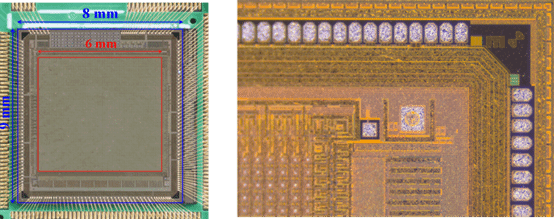
Pixel readout chip Topmetal-II

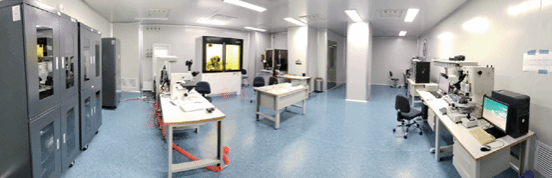
PLAC Laboratory, Central China Normal University
The article was officially published in the journal Nature on January 15, 2026. Central China Normal University is one of the core collaborating institutions for this research. Our participating teachers include Professors Sun Xiangming, Wang Dong, and Gao Chaosong, with Professor Sun Xiangming serving as a co-corresponding author. Professor Sun Xiangming stated, "The chip is the 'heart' of high-end detection equipment. Taking this breakthrough as an opportunity, our team will continue to deepen the technological iteration of the Topmetal series of chips, further enhancing their radiation resistance, energy resolution, and integration. This will provide more competitive core device support for next-generation dark matter detection experiments, high-energy physics experiments, nuclear medical imaging, and other fields, helping China achieve a leap from 'following' to 'leading' in basic physics research and advanced detection technology."